The Baroque Lute Transcriber Project
Machine learning of historical performance practice: transcribing keyboard music into French tablature for the 13-course baroque lute
The Baroque Lute Transcriber applies machine learning to the gap between two musical worlds that have stood apart since the eighteenth century. Keyboard music lives in staff notation, which records what sounds; lute music lives in French tablature, which records what the hands do — and because nearly every pitch has several possible homes on the fretboard, there is no mechanical translation between the two languages. Bridging them was once the craft of intabulation, and it died with the lute tradition itself. This project revives that craft in a new form: a corpus-philological pipeline reads the surviving record of Sylvius Leopold Weiss’s practice at glyph level, statistical models learn from it how he actually put music on the instrument, and the system uses those models to carry keyboard repertoire across the gap — not by a modern editor’s taste, but by the evidence of the tradition’s own greatest hand.
The training data is a corpus extracted at glyph level from engraved editions of the Dresden and London Weiss manuscripts: 151,091 attack events across 42 editions, each recording the exact course and fret of Weiss’s practice, tagged with its suite’s scordatura (five accords across twelve keys), and validated against high-resolution page images with an auditable evidence log.
The system is a staged pipeline:
- Parser — reads MusicXML/LilyPond into voice-separated note events
- Event generator — distinguishes attacks from sustained notes (only attacks are written in tablature)
- Mapper — enumerates every legal course-and-fret realization of each attack
- Optimizer — chooses among them using position models learned from the corpus, with conditional models (hand position, chord membership, voice function) in development
- Engraver — renders the result using glyph outlines taken from the source editions themselves
The learning is deliberately interpretable: every decision traces to counts in the corpus — the model reports where Weiss put each note, and how often, rather than asserting where it should go. Demonstrated end to end on the Goldberg Aria, Variation 1 and Quodlibet, the first Praeludium of Das wohltemperierte Klavier, Invention 1, two Menuets from the Notenbüchlein, and the Toccata and Fugue in D minor — each transposed where the lute’s compass required it and rendered as a print-ready edition. Next: context-conditional position models, corpus-derived scordatura selection, and a quantitative measure of any tablature’s fit to Weiss’s statistical fingerprint.
Transcriptions
Each is a print-ready edition produced end to end by the pipeline — parsed from the keyboard source, transposed where the lute’s compass required it, mapped to Weiss’s own positions, and engraved with glyph outlines taken from the source editions.
- Goldberg Variations, Aria — BWV 988B♭ major
- Goldberg Variations, Aria — BWV 988F major
- Goldberg Variations, Variatio 1 — BWV 988B♭ major
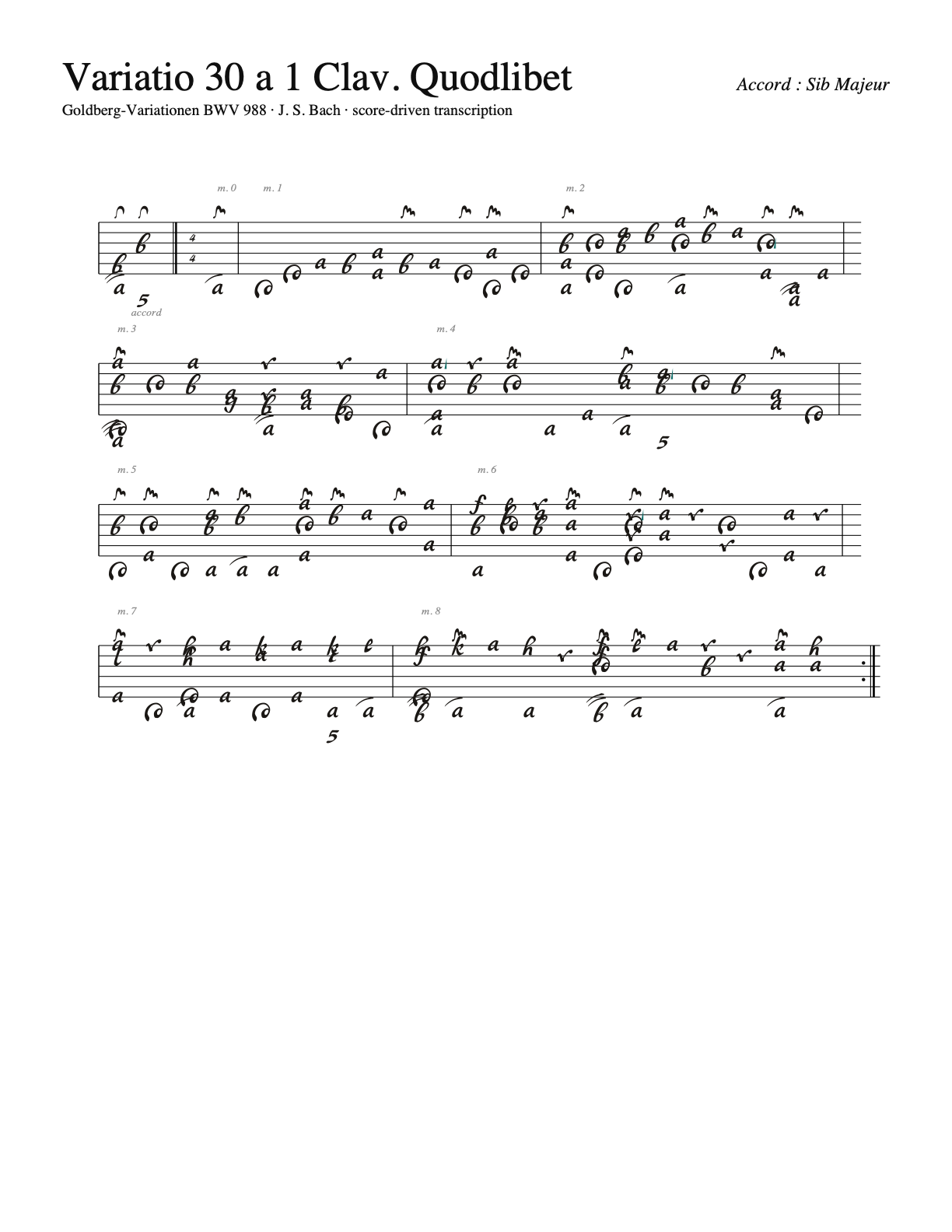
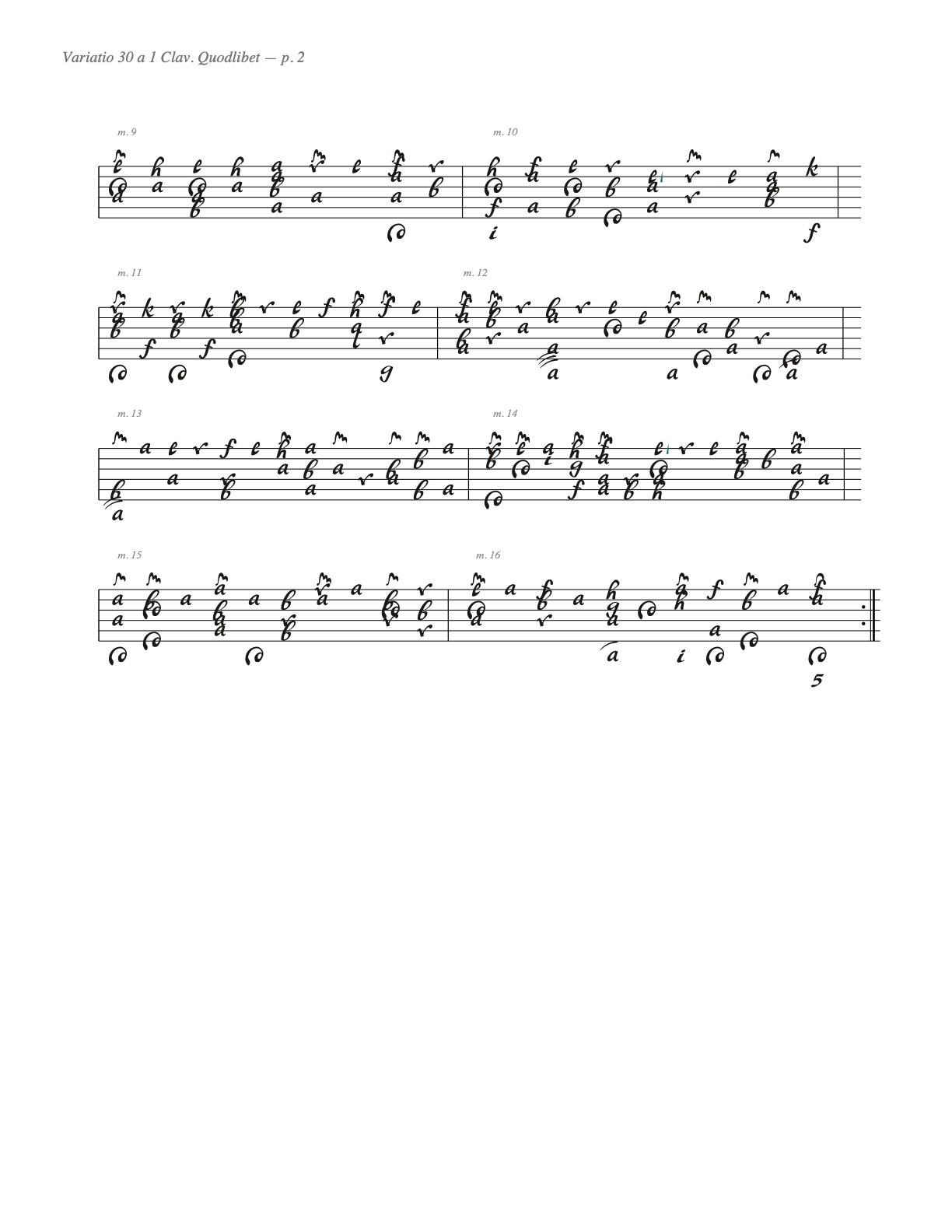
- Goldberg Variations, Variatio 30, Quodlibet — BWV 988B♭ major
- Praeludium I, Das wohltemperierte Klavier — BWV 846F major
- Invention 1 — BWV 772E♭ major
- Menuet — BWV Anh. 114B♭ major
- Menuet — BWV Anh. 115G minor
- Toccata and Fugue — BWV 565D minor
The editor
Output is rarely final on the first pass, so the pipeline ships with a small editor — a local application for correcting a course or fret by hand, auditing which position the optimizer chose and why, and re-engraving the page. It runs against a local instance of the pipeline rather than as a standalone download.
What the output looks like
The Quodlibet, both pages at a glance — six-line staves, fret letters, stacked bass strokes for the diapasons, rhythm flags above. Open it full size.